
Coyyn.com Digital Business: What the Platform Offers and How It Actually Works
Running a business today involves more moving parts than it did even five years ago. You need to send payments across borders, manage invoices, track expenses, and in many cases deal with clients who prefer paying in cryptocurrency. Handling all of this through separate tools — a bank account here, a crypto wallet there, an invoicing app somewhere else — creates friction that costs time and money.
That is the gap the coyyn.com digital business platform is designed to fill. It brings standard business finance tools together with blockchain-based payments, smart contract automation, and crypto wallet management in a single interface. This guide looks at what the platform delivers, who benefits from it, and where its current limitations sit.
What This Guide Covers
What Is the Coyyn.com Digital Business Platform?
Coyyn.com positions itself as a digital finance ecosystem built for the way businesses operate now — fast, borderless, and increasingly comfortable with both traditional currency and digital assets. The platform covers three areas that most business owners have to manage separately: conventional banking functions, cryptocurrency tools, and business operations software.
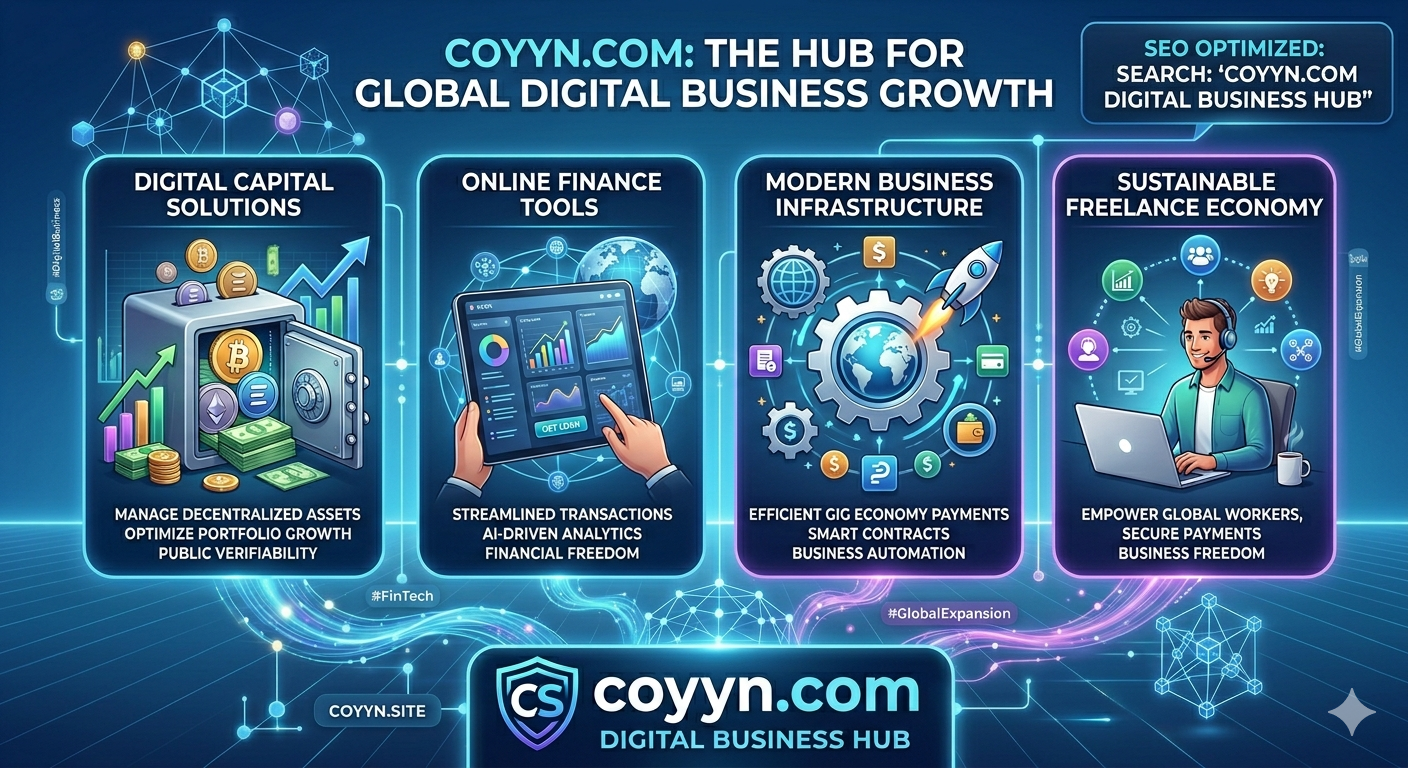
The Coyyn com digital business app is the mobile interface through which most users access the platform. It is designed for Android and iOS and is built around a unified dashboard that shows fiat balances, crypto holdings, transaction history, and business analytics in one place. The desktop version mirrors this experience for users who prefer working from a larger screen.
The technical foundation uses blockchain infrastructure — specifically distributed ledger technology — to process cross-border payments faster than conventional banking rails. Smart contracts handle automated agreements, removing the need for manual follow-up on payment milestones. Cloud-based architecture keeps the platform accessible from anywhere while enabling integrations with third-party accounting and CRM tools.
In plain terms: it is not just a banking app with a crypto section bolted on. The business tools — invoicing, payroll, expense tracking, project budgets — are integrated with the financial layer rather than existing as separate modules.
Who Uses It and Why
The platform is relevant to a fairly wide group, but it is not the right fit for everyone. Understanding who it serves well helps set realistic expectations before committing to it.
| User Type | Primary Benefit | Key Tools Used |
|---|---|---|
| Freelancers | Fast international payments, low fees | Invoicing, crypto wallet, dashboard |
| Small business owners | Consolidated finance and operations | Payroll, multi-currency, smart contracts |
| Remote teams | Cross-border payroll without wire delays | Multi-signature accounts, crypto payroll |
| Startups | Lower costs than traditional banking | Analytics, automation, DeFi tools |
| Gig economy workers | Instant settlements, no middleman delays | Digital wallet, real-time transfers |
| International traders | Fiat-to-crypto gateways, fast settlement | Multi-asset wallet, liquidity tools |
The platform makes the most sense for people who work internationally, accept or want to accept crypto payments, and are tired of managing their business finances across five different apps. It is less suited to businesses that need heavy regulatory coverage, dedicated enterprise-grade CRM features, or extensive phone-based customer support.
Core Business Features
Here is what the Coyyn com digital business app covers across its main functional areas.
Unified Business Dashboard
All financial data — fiat balances, crypto holdings, recent transactions, outstanding invoices, and spending summaries — sits on one screen. For a business owner juggling multiple accounts and currencies, this is a genuine time-saver. You do not need to log into three separate services to understand where your money stands at any given moment. The dashboard updates in real time, so the numbers you see when you open the app reflect the current position, not yesterday’s snapshot.
Invoicing and Automated Follow-Ups
The invoicing tool generates professional invoices and sends automated reminders when payment deadlines approach or are missed. This removes the uncomfortable manual follow-up process that freelancers and small agencies know well. Invoices can be settled in fiat or crypto, which is useful when you have clients in different countries who prefer different payment methods. The system logs payment status and updates the dashboard automatically once a payment clears.
Payroll Management
Businesses with small teams or remote contractors can run payroll directly through the platform. Payments go out in fiat, crypto, or a combination, depending on what each team member prefers. Cross-border payroll is processed faster than a traditional bank wire and at lower cost. For companies paying contractors in multiple countries, this removes a significant operational headache.
Multi-Currency Accounts
The platform supports over 15 fiat currencies alongside multiple digital assets. You can hold balances in different currencies without converting immediately, which helps businesses avoid unnecessary exchange losses when rates are unfavorable. Switching between currencies within the platform is handled at the current rate with fees disclosed upfront.
Expense Tracking and Spending Analytics
Transactions are categorized automatically, and the analytics layer produces spending breakdowns by category, time period, and project. An AI-backed advisory layer answers plain-language questions — you can ask what your largest expense category was last quarter and receive a direct, readable answer. Businesses can set budget limits by category and receive alerts before they are breached. Project-level budget tracking is available on higher tiers, which helps agencies and consultancies maintain clear margins across multiple clients.
Multi-Signature Business Accounts
For businesses where more than one person needs account access, multi-signature authorization adds a useful layer of control. Large outgoing payments or changes to account settings require approval from multiple authorized users before they go through. This reduces the risk of unauthorized transactions and makes internal financial controls easier to enforce without building complex approval workflows from scratch.
Business Feature Summary
| Feature | What It Does | Tier |
|---|---|---|
| Unified dashboard | Real-time view of all accounts and assets | All plans |
| Invoicing + auto-reminders | Generate, send, and follow up on invoices | All plans |
| Payroll (fiat + crypto) | Pay team members in preferred currency | Paid tier |
| Multi-currency accounts | Hold 15+ fiat currencies + crypto | All plans |
| Spending analytics | Categorized expense tracking + AI insights | Paid tier |
| Multi-signature accounts | Shared access with approval controls | Business tier |
| Smart contract automation | Auto-release payments on milestone completion | Paid tier |
| Project budget tracking | Per-project financial oversight | Business tier |
Blockchain and DeFi Tools for Business
For businesses that want to go beyond basic digital payments, the platform includes a range of decentralized finance tools that are less common in mainstream business apps.
Smart Contracts
Smart contracts are self-executing agreements written on the blockchain. In a business context, this means you can set payment conditions — for example, releasing a milestone payment only when a client marks a deliverable as complete — and the system handles the execution automatically. No chasing, no delays, no need to involve a third party to verify the agreement was met. The platform provides templates to make setup accessible even for users with no coding experience.
Fiat-to-Crypto Gateways
Businesses can convert standard currency into digital assets directly within the platform without going through a separate exchange. This is useful when paying international suppliers who prefer crypto, or when a business wants to hold a portion of its treasury in digital assets without managing a separate wallet service.
Liquidity Pools and Passive Yield
Businesses with idle digital capital can put it to work through liquidity pools. By contributing assets to the ecosystem, businesses earn a share of transaction fees — a form of passive return that traditional business savings accounts do not come close to matching. This comes with the standard risks associated with DeFi, but the platform presents it in a format that is more approachable than managing this independently through a DeFi protocol.
Multi-Asset Wallet
Bitcoin, Ethereum, stablecoins, and fiat currencies all appear in the same wallet view, with live valuations updated continuously. Businesses that accept multiple payment types can see their total holdings across asset classes without switching apps. The wallet is non-custodial for crypto holdings, meaning the business holds its own private keys rather than leaving assets under platform control.
Practical note: The DeFi features are built to be accessible to non-technical users, but they still involve real financial risk. Liquidity pools and staking returns fluctuate with market conditions. These tools make sense for businesses that understand what they are doing with digital assets, not as a default option for every user on the platform.
Security and Compliance
Any business platform that handles payments and financial data needs to answer basic security questions clearly. Here is what the coyyn.com digital business platform uses.
- End-to-end encryption — all data is encrypted both in storage and during transmission between devices and servers
- Two-factor authentication (2FA) — required for login and any high-value transaction or account change
- Biometric login — fingerprint and facial recognition supported on compatible devices
- Real-time fraud monitoring — suspicious activity is flagged and blocked automatically, with push notifications sent immediately
- Cold storage — 95% of crypto assets are held offline in cold storage using multi-signature wallet security
- GDPR compliance — user data is not sold to third parties and is handled within regulatory privacy frameworks
- KYC and AML procedures — the platform applies Know Your Customer and Anti-Money Laundering checks as part of account verification
- Regular security audits — third-party audits are conducted to identify vulnerabilities before they are exploited
For businesses with multiple authorized users, the multi-signature requirement means that large transactions or sensitive account changes cannot be pushed through by a single person acting alone. This matters for internal financial controls.
Regulatory note: Coyyn operates as a Virtual Asset Service Provider (VASP), which means it follows digital asset regulations but is not a licensed bank. Business deposits are not covered by government-backed deposit insurance schemes. Businesses depositing significant operating funds should factor this into their risk assessment.
Pricing and Fees
The platform offers a tiered structure. Basic features and educational content are accessible without paying. Advanced business tools sit behind paid plans.
| Cost Item | Amount | Notes |
|---|---|---|
| Free plan | $0 | Basic tools, wallet, dashboard access |
| Business plan (entry) | ~$15 / month | Invoicing, analytics, payroll included |
| Business plan (advanced) | ~$45 / month | Multi-sig, project tracking, DeFi tools |
| Domestic transfers (above $100) | Free | Small fee may apply below $100 |
| International transfers | 0.5% – 2.1% | Varies by corridor and currency |
| Crypto trading | 0.1% – 0.25% | Competitive with major exchanges |
| Volatility spread | 0.2% – 0.5% | Applied during high market movement |
| Inactivity fee | After 12 months | Exact amount not publicly confirmed |
Compared to running payroll through a traditional bank wire alongside a separate invoicing tool and a crypto exchange, the bundled cost of Coyyn’s paid plan is often lower. The volatility spread and inactivity fee are the two most commonly overlooked costs — worth reading the current terms before committing.
Pros and Cons
What Works Well
- Single platform for banking, crypto, and business tools
- Smart contracts remove payment disputes
- Competitive international transfer fees
- Free domestic transfers above $100
- Non-custodial crypto wallet
- Multi-signature account controls
- Automated invoicing and follow-ups
- Cross-border payroll in crypto or fiat
- Real-time fraud monitoring
- GDPR compliant data handling
Limitations to Know
- Not a licensed bank — no deposit insurance
- Limited regulatory transparency
- Customer support response times are inconsistent
- No phone support around the clock
- Some app stability issues at peak usage
- Advanced tools require paid plan
- Inactivity fee after 12 months
- Hidden spread during volatile markets
- Limited long-term user review base
- Not suited for complex enterprise workflows
How It Compares to Alternatives
Businesses evaluating the coyyn.com digital business platform typically compare it against a few alternatives. The table below is based on publicly available information across platforms.
| Platform | Crypto Tools | Business Invoicing | Intl. Fees | Regulated |
|---|---|---|---|---|
| Coyyn.com | Full — DeFi, staking, smart contracts | Yes — with auto-reminders | 0.5% – 2.1% | VASP only |
| Revolut Business | Basic crypto | Yes | 0.3% – 1.5% | Yes (FCA, EMI) |
| Wise Business | None | Basic | 0.35% – 1.0% | Yes |
| PayPal Business | Very limited | Yes | 1.5% – 4% | Yes |
| Traditional Bank | Rarely | No | 3% – 5%+ | Fully |
Revolut Business offers better regulatory coverage and slightly lower international fees on some corridors. Wise is the better choice if your only need is low-cost international transfers with no crypto involvement. Where Coyyn pulls ahead is the combination of deep crypto integration, smart contracts, and business invoicing — that bundle does not exist on either Revolut or Wise in the same form.
Getting Started with Coyyn.com Digital Business
The onboarding process is relatively quick. Most users are operational within a week of creating an account.
- Create your account — sign up with a business email, complete identity verification (KYC), and add your business details
- Set up your dashboard — connect existing bank accounts or fund your wallet to activate the financial tools
- Configure invoicing — add your business name, payment terms, and any recurring client details
- Add team members — if you need shared access, set up multi-signature permissions before adding other users
- Test with small transactions — before running payroll or large transfers, run a small test payment to confirm everything processes correctly
- Review the fee schedule — check the current terms for international transfer rates and any plan-specific fees before your first billing cycle
Recommended approach: Start on the free plan. Use the basic invoicing and wallet tools for your first month. If the platform handles your volume and currency mix without issues, upgrade to a paid tier that matches your actual usage. Many users find they do not need the highest tier.
Frequently Asked Questions
Is the Coyyn com digital business app suitable for businesses with no crypto background?
Yes. The platform is built to be usable by people who are entirely new to digital assets. Crypto and DeFi features are accessible but not mandatory — you can use the business invoicing, payroll, and multi-currency banking tools without touching the crypto side. Simple mode options hide advanced functionality until you actively choose to explore it.
How does the platform handle international payroll?
Payroll payments can be sent in fiat, cryptocurrency, or a mix of both depending on what each recipient prefers. Cross-border payments process through the platform’s blockchain infrastructure, which is faster than conventional wire transfers and carries fees between 0.5% and 2.1%. Payments do not queue on business days — they can go out any time.
Can multiple people manage a single business account?
Yes. Multi-signature account support is available on business tiers. You can assign multiple authorized users and set rules requiring approval from more than one person before large transactions or account changes go through. This is useful for maintaining internal financial controls without building separate approval workflows.
What happens to business funds if the platform shuts down?
Fiat funds are held in partner banks and cryptocurrency private keys are held in escrow. This means business funds are not lost instantly if the platform ceases operation, but recovery could be a slower process than withdrawing from a regulated bank account. Businesses holding large balances should factor this into their risk planning.
Does the platform integrate with accounting software?
Cloud-based integration is part of the platform’s architecture, and it supports connections with third-party business tools. The depth of integration with specific accounting software depends on the tier and the tool in question. It is worth testing your specific accounting setup during the free trial period before committing to a paid plan.
Is Coyyn.com a licensed bank?
No. Coyyn operates as a Virtual Asset Service Provider and a digital finance platform, not as a licensed banking institution. It is not subject to the same regulatory requirements as a bank, and business deposits do not carry government-backed insurance. Businesses that require the full legal protections of a regulated bank should use a licensed institution for their primary accounts and consider Coyyn as a complementary tool.
Final Assessment
The coyyn.com digital business platform is a serious option for businesses that are tired of running their finances across multiple disconnected tools. The combination of invoicing, payroll, multi-currency banking, and deep crypto integration in one place is not common — and the fee structure, particularly for international work, is genuinely competitive against what traditional banks charge.
The limitations are real and worth stating plainly. It is not a regulated bank. Customer support has room to improve. Businesses holding significant operating capital should understand the deposit protection situation before moving large sums onto the platform.
The sensible way to approach it is to start small. Use the free plan, test the features that matter most to your business, and build up from there once you have confirmed the platform handles your workload reliably. For businesses that work internationally, pay contractors in crypto, or want smart contract automation without hiring a developer, it covers a lot of ground in one place.
For businesses with straightforward domestic needs or those that require the full protection of a licensed institution, a regulated alternative is the safer starting point.